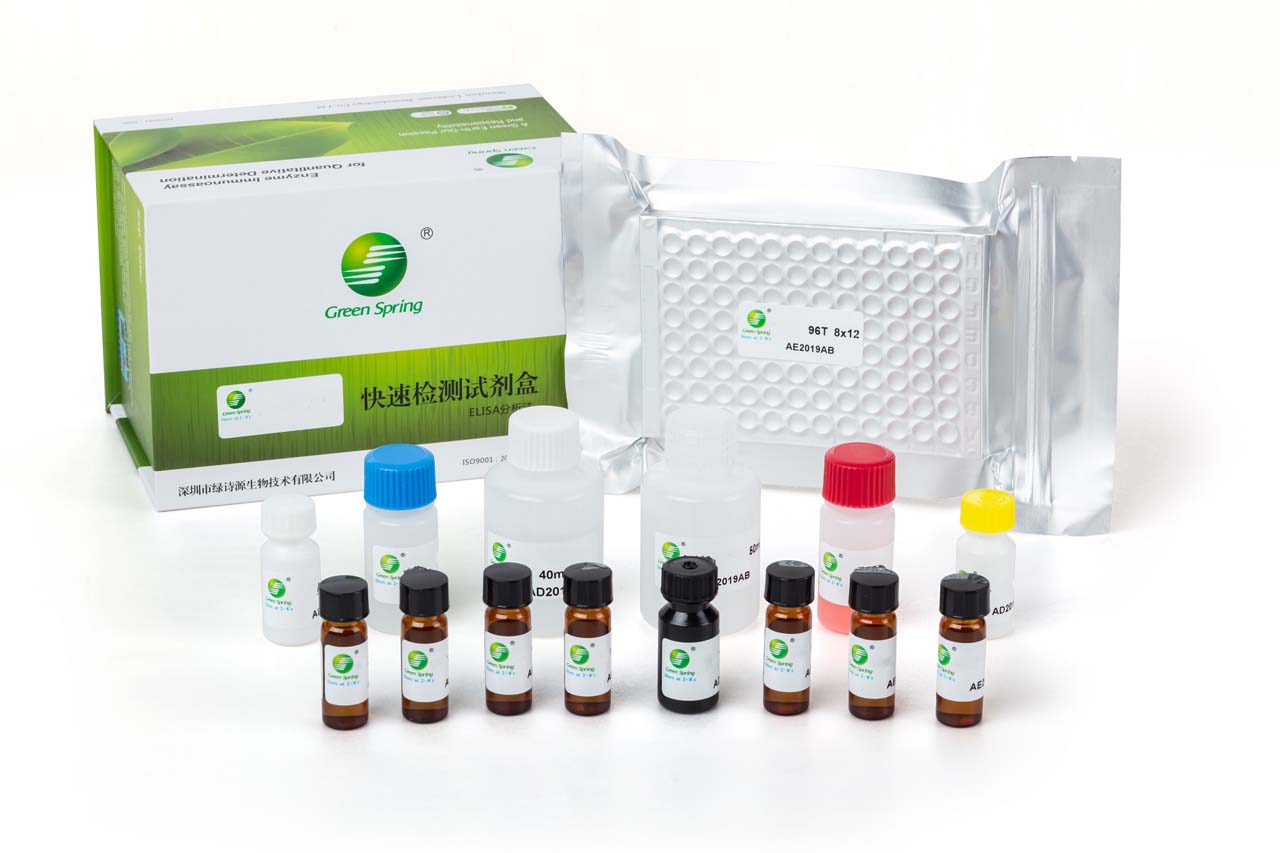
BTSQ Beta-lactams, Tetracyclines, Sulfonamides and Quinolones 4in1 Combo rapid test strip
- Aug 27, 2026 Anon
Beta-lactams, Tetracyclines, Sulfonamides and Quinolones 4in1 Combo rapid test strip
Catalogue No.: LSY-20104
1. Brief
The Beta-lactams, Tetracyclines, Sulfonamides and Quinolones Combo rapid test strip, based on Colloidal gold immunochromatography assay method, is used for testing Beta-lactams, Tetracyclines, Sulfonamides and Quinolones residues in dairy products quickly.
2. Specifications
(1) 8microwells and 8 dipsticks in one bottle 12 bottles / kit.
(2) Instruction 1 piece
3. Principle
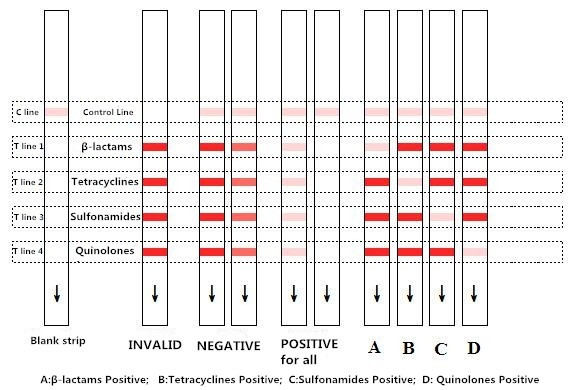
The Beta-lactams, Tetracyclines, Sulfonamides and Quinolones Combo rapid test strip is based on competitive inhibition immuno-chromatographic principle. When the antibiotics residue in sample is higher than or equal to the detection limit, it will combine with labeled antibody, then inhibit the combination between colloidal gold antibody coated antigen on T line, making T line lighter than C line or T line invisible or T line has same color with C line. Otherwise, T line is darker than C line. No matter whether there is antibiotics residue in sample, C line is visible.
4. Application
Dairy products: fresh milk, pasteurized milk, pure cow/goat milk, whole milk powder (dissolve 1g of milk powder in 9ml of pure water and mix thoroughly)
5. Detection limit (See Tablet 1)
6. Operation procedures
1) Read the manual carefully before testing, return test strips and milk sample into room temperature before use.
2) Take bottles needed from the kit package, take out required microwells, making proper marks, Please use it in 1 hour. Seal the cap of the bottles, avoid moisture.
3) Use Micro-pipette to take 200ul of the samples into the microwells, then repeatedly absorb for 5 times, mix the sample with the reagent in the microwells completely until no solid judged by eyes (this is a very important step).
4) Incubate at (40±2℃) for 5min, then insert the strip into micro-well, put the end with MAX down into the liquid.
5) Insert the strip into the liquid for 5min, then read the result.
7. Test Result Interpretation
Color depth comparison of T line and C line | Result judgment | Result analysis |
T line > C line | Negative | antibiotics residue is lower than detection limit in sample |
T line = C line | Weak positive | antibiotics residue is equal to detection limit in sample |
T line < C line or T line is invisible | Positive | antibiotics residue is higher than detection limit in sample |
C line is invisible | Invalid | The test dipstick is invalid, test again |
8. Results picture show
9. Precautions
1) This product is suitable for pure milk of cattle and sheep and raw milk.
2) Test dipsticks and micro-wells are disposable,do not use test dipsticks out of date.
3) Please seal the bottle after taking out required test dipsticks. If can not use all 8 microwells at once, cup the rest and put it back to bottle and sealed.
4) Do not touch the white membrane surface in the middle of test dipsticks, avoid sunlight and fan blowing directly.
5) Store milk sample in cold, no more than 3 days.
6) Milk samples should be fully liquid without any agglomeration, sour and precipitation. Stir milk sample to even before test.
7) For milk sample with high fat content, chromatography is slow, recommending extension the second step for another 1 min.
8) Use the test dipsticks testing again for positive results.
10. Safety performance and garbage disposal
This product's test strips and packaging are non-toxic and harmless. After use, they should be disposed of as dry waste.
11. Storage and expiry date
Storage: Store at 2-8 ℃ in sealed, dry, and dark place, no frozen.
Expiry date: 12 months; date of production is on box.
Shenzhen Lvshiyuan Biotechnology Co., Ltd
D Building, National Biological Industrial Park of Marinelife, No.2 Binhai Road, Dapeng, Shenzhen, 518120 China
Tel. 86-755-28438788/86-18165709090
Fax 86-755-28938800
Email: info@lsybt.com
Tablet 1
β-lactams | Detection limit (ppb) | Sulfonamides | Detection limit (ppb) | Quinolones | Detection limit (ppb) | Tetracyclines | Detection limit (ppb) |
Penicillin G | 2~4 | Sulfadiazine (SD or SDZ) | 3-5 | Enrofloxacin | 2-3 | Tetracycline | 5-10 |
Amoxicillin | 2~3 | Sulfamerazine (SM1) | 3-5 | Ciprofloxacin | 2-3 | Oxytetracycline | 5-10 |
Ampicillin | 2~3 | Sulfamonomethoxine (SMM) | 2-3 | Norfloxacin | 2-3 | Chlortetracycline | 5-10 |
Oxacillin | 5~7 | Sulfadimethoxypyrimidine | 3-5 | Pefloxaein | 2-3 | Doxycycline | 8-10 |
Cloxacillin | 4~6 | Sulfathiazole(ST) | 5-8 | Sarafloxacin | 2-3 | ||
Piperacillin | 6~8 | Sulfamethoxypyridazine (SMP) | 8-10 | Ofloxacin | 2-3 | ||
Nafcillin | 15~25 | Sulfaquinoxaline(SQX) | 25-30 | Danofloxacin | 2-4 | ||
Dicloxacillin | 6~8 | Sulfamethoxazole (SMZ) | 10-15 | Flumequine | 2-3 | ||
Cefquinome | 8~15 | Sulfamethazine(SM2) | 5-8 | Enoxacin | 3-5 | ||
Cefalotin | 30~40 | Sulfamethoxydiazine(SMD) | 2-3 | Lomefloxacin | 2-3 | ||
Cefazolin | 40~50 | Sulfafurazole(SIZ) | 30-40 | Marbofloxacin | 3-5 | ||
Cephalonium | 8~10 | Sulfalen | 20-25 | Nadifloxacin | 3-5 | ||
Cefacetrile | 20~30 | Sulfachloropyridazine (SCPA) | 10-15 | Bifloxacin | 3-5 | ||
Cefoperazone | 3~5 | Sulfapyridine | 50-60 | 5-8 | |||
Cephapirin | 8~10 | Sulfadimoxine (SDM2) | 20-30 | Oxolinic Acid | 2-3 | ||
Ceftiofur | 60~100 | Sulfacetamide | 50-60 |